
Home > History
The Association of Ukrainian Regions “EU Strategy for the Danube Region” was founded in 2015 as a key instrument for implementing the European Strategy for the Danube Region, which was adopted by the EU Council on June 24, 2011. The Strategy unites 14 countries, including Ukraine, where the Association has become the main communication platform for the Odesa, Ivano-Frankivsk, Zakarpattia, and Chernivtsi regions. It focuses on the development of Ukraine’s Danube regions and the deepening of cooperation with neighboring countries.
The Association’s mission is to create favorable conditions for international cooperation, fostering economic, social, political, environmental, tourism, and investment opportunities that contribute to the region’s integration into the European space. The organization operates based on the values of partnership, sustainable development, inclusion, openness to innovation, and joint efforts to address the pressing challenges faced by the Danube region.
We firmly believe that preserving natural resources, improving the quality of life for communities, and stimulating economic growth are essential components of sustainable societal development. Only through effective interaction between government institutions, businesses, and local communities can we create conditions for the harmonious coexistence of social, economic, and environmental interests across the entire country.
Our approach is founded on the principles of transparency, openness, and accountability. We strive to create an environment where every community has the opportunity to grow while preserving its natural heritage, integrating energy-efficient technologies, supporting cultural diversity, and implementing inclusive practices. Economic progress should serve as the foundation for enhancing the quality of life for both present and future generations.
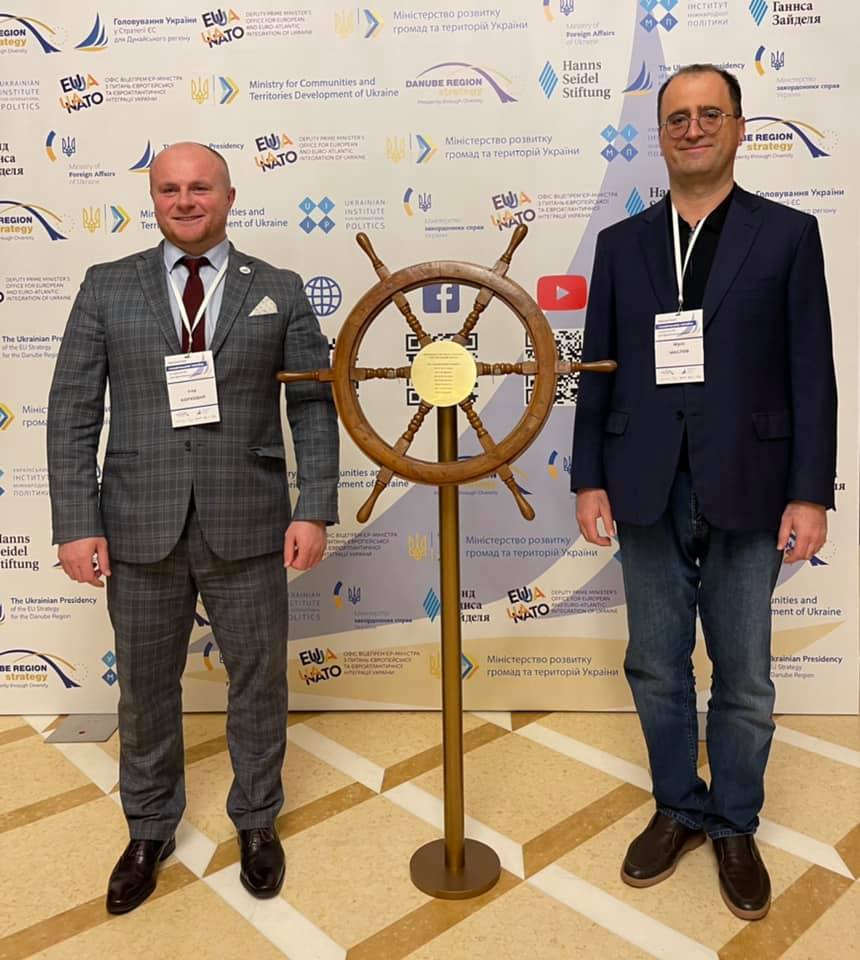
The official commencement of the Association’s activities was marked by the signing of a memorandum of cooperation on February 18, 2015, by the regional councils of Ukraine. The memorandum defined the organization’s primary goal: to create favorable conditions for international cooperation with neighboring countries and to strengthen Ukraine’s economic, social, political, environmental, tourism, and investment positions through the development of the four regions’ potential within the framework of the EU Strategy for the Danube Region (EUSDR). In 2015, the Association laid the foundation for its activities, becoming a platform for coordinating efforts between regions and international partners.
Since 2016, the Association has been actively involved in international projects. From 2018 to 2022, the Branch Office in Odesa served as the technical secretariat of the Joint Operational Program for Cross-Border Cooperation “Romania-Ukraine 2014–2020.” This office became a crucial hub for project coordination, information exchange, and strengthening cooperation between partners from both countries.
Several projects have been successfully implemented:
“HEALTH/4.1/1” – modernization of Izmail City Hospital, supply of medical equipment, and improvement of healthcare services. Through this project, the Danube Regional Hospital received a CT scanner installed in the consultative and diagnostic department, an endoscopic system, a water distiller for the laboratory, a steam sterilizer, a Holter monitor for the cardiac surgery department, and an ergometer for the rehabilitation unit.
“Integrated Emergency Response System in the Danube Delta” – creation of safety infrastructure, training of rescuers, and implementation of early warning systems. As part of the project, modern sirens and an early warning system were installed in Reni Territorial Community. The project also plans to purchase specialized fire protection gear for the fire station in Reni.
SAGA-type projects – cross-border cooperation in law enforcement and crime prevention.
In partnership with European institutions and Ukrainian central government bodies, particularly the Ministry for Communities and Territories Development of Ukraine, the Association ensured proper coordination, support, and implementation of projects that had a tangible impact on the well-being of the Odesa region’s population and the region’s integration into the European space.
In 2017, the Association developed an implementation plan for the Danube Strategy in the Odesa region. During this period, it also acted as a consultant for the LSP project “Inventory, Assessment, and Rehabilitation of Anthropogenic Pollution Sources in the Lower Danube of Ukraine, Romania, and Moldova” under the “Romania-Ukraine-Moldova 2007–2013” program. This project helped identify and mitigate pollution impacts on the Danube ecosystem, marking a significant step toward the region’s sustainable development.
Together with the Ministry of Information Policy of Ukraine, the Association organized various events within the VIII EU Danube Strategy Forum in Bucharest, Romania, in 2019. This forum served as a platform to affirm that Ukrainian regions are full-fledged representatives of the Danube region and worthy partners. The Association also presented the Ukraine NOW brand at this forum. The event was a milestone, showcasing Ukraine’s achievements within the strategy and providing the Association with an opportunity to establish itself on the international stage, highlighting the contribution of the Danube regions to the country’s development.
In 2019, the Association achieved significant success by winning the “Small Cities – Big Impressions” competition, organized by the Ministry of Culture of Ukraine, in two projects: the Dniester Heritage Gastronomy Festival in Mayaky and the establishment of the Multinational Cultural Residence “DANUBE HQ” in Reni. These victories recognized the Association’s efforts in enhancing the cultural potential of small communities in the Danube region. Projects such as the “Ukrainian Bessarabia” Art Festival, the XVIII International Bulgarian Culture Festival “Bulgarians – Let’s Stay Bulgarians!”, and the Bandura Fusion Festival further demonstrated the Association’s active support for cultural development in the region.
In 2021, the Association became a co-partner of the “Ukrainian Book Museum” project, based at the Odesa Regional Universal Scientific Library named after M. S. Hrushevskyi. This museum serves as a modern platform for dialogue and the development of Ukrainian national culture, hosting excursions, poetry readings, and expert discussions.
In November 2021, the Association won the “Bridges of Cooperation: Addressing Community Issues on the EU Border” competition by the International Renaissance Foundation with the project “Danube Ferry Cooperation with the EU – Orlivka-Isaccea”, aimed at joint community development.
That same year, the Association became the winner of the “Interregional Innovation Center for Rural Development Support ‘Smart Agro Hub'” project, implemented under EU sectoral support through the Ministry for Communities and Territories Development of Ukraine. This project aimed to create a sustainable institutional platform to support agricultural producers, develop agricultural cooperation, introduce innovative farming approaches, digitize agricultural production, and expand exports from Ukrainian regions in the Danube basin.
Thanks to the establishment of the Danube Agricultural Hub, the project achieved the following:
United farmers, SMEs, local governments, educational institutions, and businesses into a partnership platform;
Conducted training, mentoring programs, and agronomic trainer preparation;
Implemented digital tools for farm monitoring and management;
Developed agricultural cooperation models for remote communities;
Created a communication bridge with EU markets through the Danube corridor.
In 2022, Ukraine became the first non-EU country to chair the EU Strategy for the Danube Region, a significant milestone that opened new opportunities for its participation in European initiatives. As a representative of Ukraine in this strategy, the Association of Ukrainian Regions “EU Strategy for the Danube Region” strengthened its position and expanded its operational capabilities.
Ukraine’s chairmanship allowed the Association to become a key coordinator and leader in implementing regional projects. It actively promoted the sustainable development of the Danube region by engaging new partners and reinforcing cooperation with existing ones. Additionally, the Association played a crucial role in implementing initiatives aimed at exchanging experiences among participating countries.
During this period, the Association implemented numerous projects in ecology, tourism, and education, showcasing its leadership capabilities and contributing to Ukraine’s European integration. Ukraine’s chairmanship in the Strategy provided a strong impetus for the Association to demonstrate its proactive stance and make a significant impact on the region’s development.
Following the full-scale invasion of Ukraine by Russia in 2022, the Association joined volunteer initiatives. It became a co-partner in the “Isaccea Humanitarian Hub” project in Romania, which organized Romanian language courses in Tulcea and Isaccea and facilitated the social adaptation of Ukrainian refugees.
From 2022 to 2024, the Association prepared analytical materials and participated in shaping state policy on European integration and regional development. In 2024, its primary objective became advocating for the interests of water users in the adoption of the Lower Danube River Basin Management Plan (LDRBMP), underscoring its commitment to the restoration and sustainable development of the Danube region.
In 2025, the Association expanded its activities by partnering with the Ukraine Rebuilding Alliance, the Maritime Ecological Association, and the Black Sea Resource Center, opening new opportunities for regional project implementation. It also initiated work on the “Improving Access to Education in Border Regions as a Key Factor for Socialization and EU Integration” cross-border project under the Interreg NEXT Romania-Ukraine 2021–2027program. This project aims to enhance education and community integration into the EU.