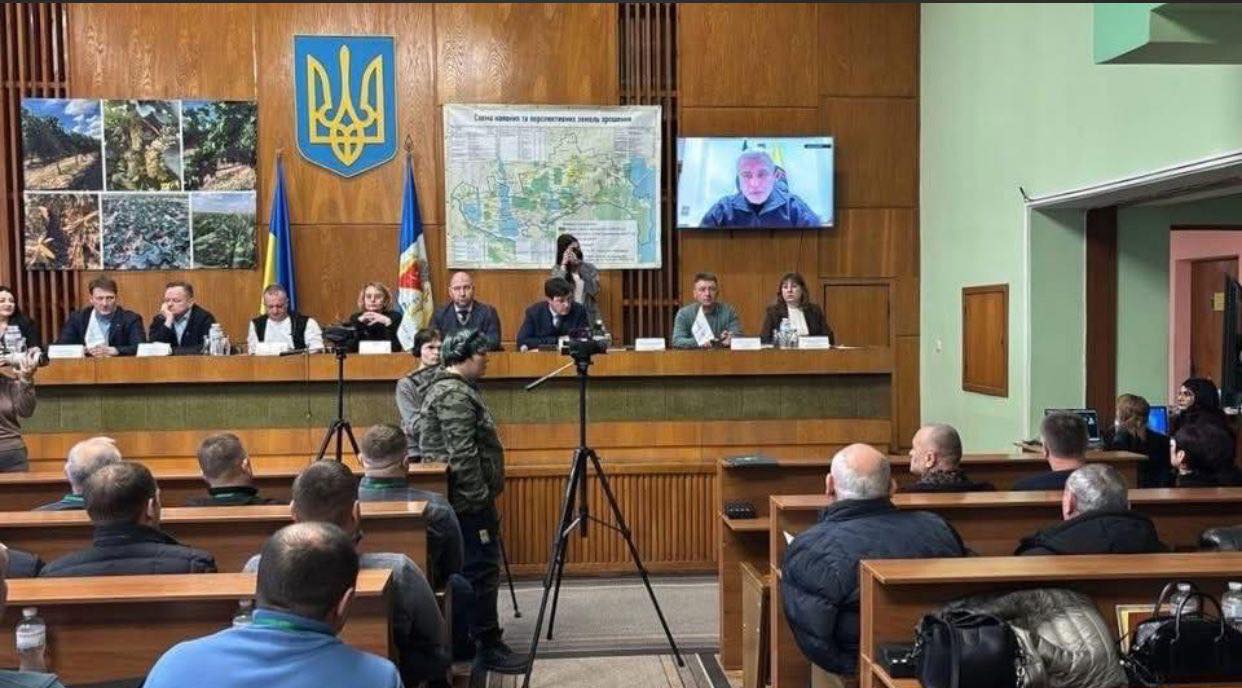
On January 30, the Forum of Odesa Region Farmers titled “Voice of the Land: The Economy Begins in the Field” took place in the city of Izmail. The forum served as an open professional platform for dialogue between public authorities, sectoral institutions, and agricultural producers on the key challenges facing the development of the agricultural sector in Southern Ukraine amid martial law and accelerating climate change.
The event brought together the Head of the Odesa Regional Military Administration Oleh Kiper (online), Chair of the Verkhovna Rada Committee on Agrarian and Land Policy Oleksandr Haidu, Deputy Minister of Economy of Ukraine for Agricultural Development Taras Vysotskyi, Deputy Minister of Economy for Irrigation and Water Management Iryna Ovcharenko, Members of Parliament of Ukraine, representatives of the All-Ukrainian Agrarian Council, farmers of Odesa region, and representatives of профильні state institutions. The broad and high-level participation highlighted the strategic importance of agriculture for both the region and the country as a whole.
Discussions focused on issues that directly affect the economic stability of agricultural producers in Odesa region. In particular, participants addressed the potential reinstatement of export duties on soybeans and rapeseed under Draft Law No. 14226 and emphasized the associated risks for producers and exporters. Considerable attention was also paid to the legislative regulation of the use of privately owned agricultural land for fortification needs and compensation mechanisms for farmers, as envisaged by Draft Law No. 14117, which is especially relevant for border and frontline communities.
Logistics and access to mineral fertilizers constituted another important topic of the forum. Participants discussed the ban on maritime imports of ammonium nitrate through the ports of Odesa region and the urgent need to identify alternative, safe supply routes. According to the conclusions of an interagency commission, the transshipment of explosive fertilizers in the ports of the Danube region is not possible, which necessitates comprehensive solutions at the national policy level.
Systemic land-related issues were also addressed. These included the need to adopt legislation on the consolidation of agricultural land, as well as the introduction of a moisture coefficient for arid territories when determining the normative monetary valuation of land. These instruments are viewed as essential for fair land regulation and for adapting agricultural production to the climatic conditions of Southern Ukraine.
A key thematic block of the forum was dedicated to irrigation reform and water resource management. In Odesa region, 16 Water User Organizations have already been established, four of which have received ownership of irrigation infrastructure facilities. Reconstruction projects are currently being implemented for the Izmail, Tashbunar, and Nahirnianske irrigation systems. More than UAH 100 million has been allocated from the regional budget for irrigation restoration, and an additional EUR 6.1 million in grant funding from Italian partners is planned. Participants emphasized that the adoption of Draft Law No. 7577 is a critical prerequisite for further development of irrigation systems and for strengthening the region’s food security.
Special attention was given to the critical situation of water resources in the Danube area. Participants highlighted the severe shallowing of the Danube lakes, low-water floods of the Danube River, and the need for state funding for the forced replenishment of lakes, similar to the measures implemented in 2022. The importance of interstate cooperation and the development of the Danube region were emphasized as integral components of Ukraine’s food security and sustainable development of border territories.
The Forum of Odesa Region Farmers proved to be an effective platform for developing coordinated positions and practical solutions aimed at adapting the agricultural sector to wartime conditions, climate change, and the requirements of the European market. The event reaffirmed the shared commitment of public authorities and the agricultural community to preserving the competitiveness of Ukrainian farmers and strengthening national food security.